Tuesday, 22 January 2013

Beginning of Work Shopping


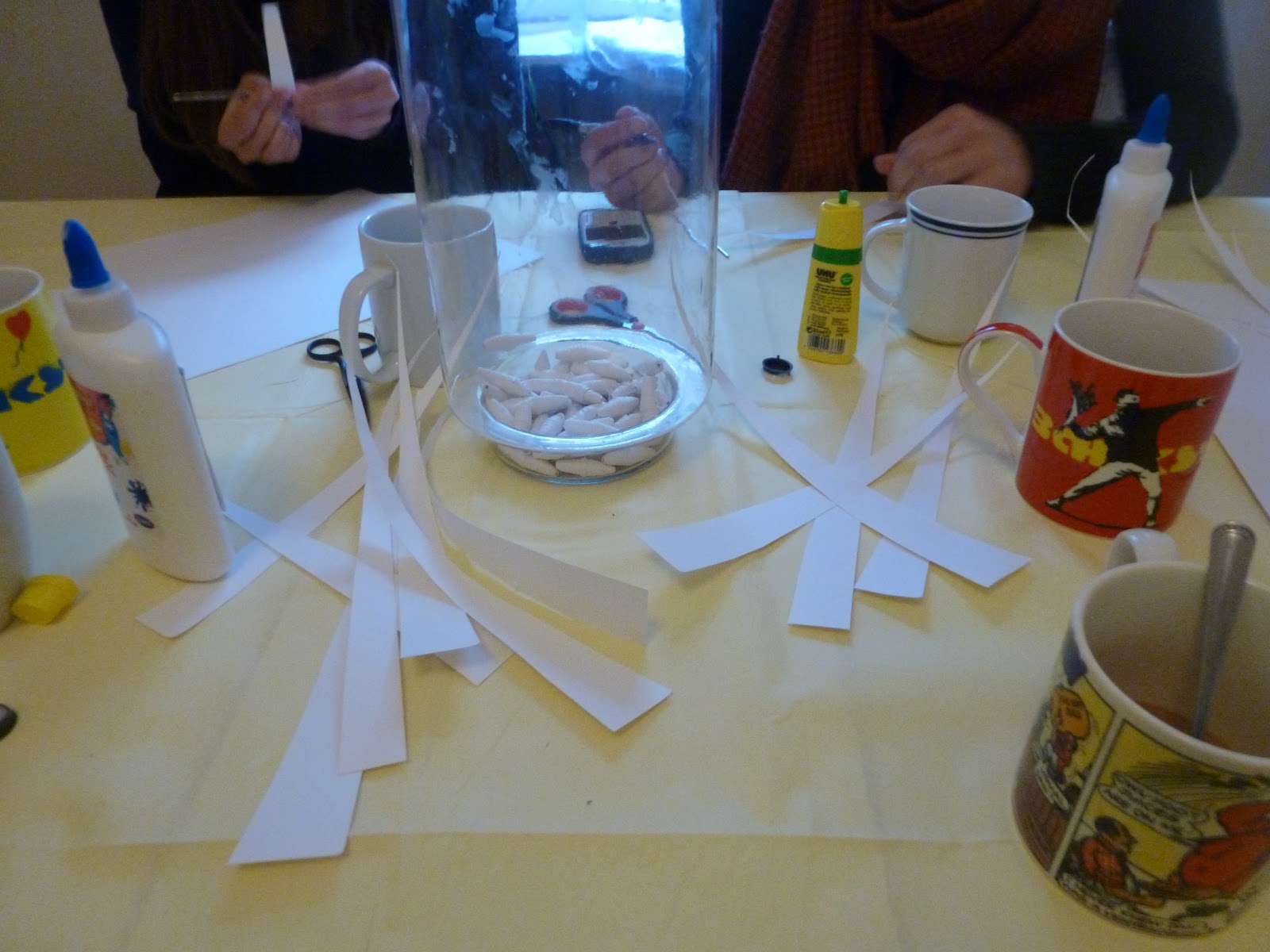
I've begun to start work shopping. The first work shop was in my apartment in Edinburgh with several female doctorate students came, chit chatted and made beads. The second work shop was in Seattle with several mixed gender thirty somethings to early 60s.

The first group ended up talking mainly about women'd rights and feminism. They ended up enjoying themselves greatly and lingered for quite a while. Later several of the girls asked if I was going to make another workshop so they could do it again. The second group ended up talking about family, how to take care of children, issues, and ideals. Several people have asked if they can continue making beads and send them to me here in Edinburgh.

Thursday, 13 December 2012

A Brief Overview on Paper Beads


          During my short time in paper bead making, I have found out many interesting things about these little objects that lead me to believe that they contain a great deal of meaning. The first time I had heard of these beads was when I traveled to Goma, an eastern city of The Democratic Republic of the Congo. I visited a center for children who had undergone a great deal of trauma one way or another. The center was called The New Hope Center. It was a home for children who lost their parents to HIV/AIDS, or who witnessed their entire village slaughtered by rebel armies or other unimaginable things.
            For them, making paper bead jewelry was a form of therapy to be able to help them through the fact that they had been through horrors no one should endure. The center would then ship the jewelry out to western countries in hopes of selling them and making money to help pay for these children’s tuition. I then later saw the beads sold all over Uganda in touristy places. I found out later that paper bead making is quite popular in Uganda, and is usually connected to social entrepreneurial programs in hopes to help impoverished women up on their feet. Other such programs are also located in nations such as Rwanda, Kenya and South Africa.
            I myself made almost two thousand beads, and I was impressed after such a number was completed, that women make as many as they possibly can as a living. However, I realized that in order to make a profit from making paper bead jewelry, one would have to make thousands of beads daily. The reason for this is because even though two thousand beads is an impressive number, it really doesn’t make enough to create the number of necklaces or earrings, which would be then sold at a nominal price. As someone who is not in the least professional in bead making, I have only been able to make one hundred beads in a period of many hours. Although the process of making beads is easy and cheap, after the five hundredth bead, my fingers would become raw and painful to the touch, until finally the one-thousandth bead would give the calluses I needed to carry on.
            In the West, in places like the United States, the United Kingdom and Australia, beads have begun a renewed interested because of the influx of paper bead jewelry coming in from Africa. However, due to ignorance, these beads have become eroticized and are widely considered a quaint item to help shabby clothes become bright and give an “African” flavor. Ironically the tradition of paper bead making came from the United Kingdom in the late nineteenth century. Using fair trade, many stores such as Walmart and Wholefoods have sold this jewelry advertising them as “you can empower you wardrobe by empowering a woman who made these beads.” Giving the buyer a sense of good will and charitable giving.
            For me, paper beads walk a fine line between being exploitative or of being full of meaning. Without the western market to buy paper bead the women in Uganda, Rwanda, Kenya, ect. would be back to nothing, trying to find another way of supporting themselves or their families. Paper bead making has become many things to many people, a way of income, a therapy, or merely just a fun pastime. I believe, as touchy as they can be, they should remain what they are right now, a little help to those who need it, until something better might come along. 
Friday, 7 December 2012

Sculpture Court


Tuesday the 4th of December, I moved my studio to the Sculpture Court in hopes that people might come up to me and I would teach them how to make paper beads. I decided to cover myself with an apron to signify placing a work place into a location specified for displaying things. I then bought candy to perhaps lure people to come up to me. I think that this would have been far more successful had I not been in the Sculpture Court. I might choose to do this again outside of the University of Edinburgh Library or in some sort of non artistic location so that people might be more curious about what I am doing. I did get people to come up to me and write something in the bead that they made. However, being that everyone was stressed for time because of the end of the semester, I wasn't able to get as many people to come up to me, try as I might. This Sunday I am going to have my first get together teaching a handful of people how to make beads. I hope to have more of these types of events next semester.

Loads of Beads

This semester I have somehow managed to make 1,737 beads. 1,208 of those beads are blank and covered in a general adhesive. 502 are also blank but covered in GAC 800. 22 of the beads have something meaningful printed in them from one of my social networking sites and the rest was from sitting in the sculpture court, and also has something meaningful written in them.

Tuesday, 20 November 2012

Murmur: Co2 project space


The Co2 project space turned out, I believe, rather well. Of course there were quite a few anxieties right before the actual show due to typical technology push-backs, but luckily for me and Tomoko, everything worked out great.

Tomoko Tabuchi and I both decided to join together to create a collaborative piece of art for the Co2 project space, which was shown last Friday. Looking at her work I decided to dust off my video editing skills and work with the concept that she has been working on in the past year. In our first meeting we talked about the idea of going to a specific location, where Tomoko would take ten photographs in 360ยบ every day during various times of the day for five days. After that, she would give me the photographs when she was done and I would edit them using Final Cut Pro piecing the photos together so that they would create a continuous, horizontal image. I ended up with three quicktime videos two of which had three of Tomoko's images on them, and one of the videos only had two. I ended up editing out two of the photos because I felt that they were not necessary for the project.

While editing, I found that the videos had a calming affect, making me feel contemplative and thoughtful. As individual photos, there wasn't really much going on other than a pretty scenery with the occasional passerby. But placed together, the scenes moved and changed vaguely, but quickly which gave my eyes something that could distract them for a while and not become bored. I found that though it was rather vague, there were small stories coming out of the images, as people walked past, the weather changed and leaves fell. I realized that what Tomoko and I were creating was an experience.


Dealing with the actual room Co2 was the difficult part. I borrowed three projectors and three DVD players from the University of Edinburgh and had to figure out where to place them in the room without them being in the way, without being visible, and without (I feared) ruining each others images by cross beaming. I was advised not to place them on plinths being that plinths are hard to find and make, but instead I should build shelves in the wall instead. So this was the plan. I bought shelves, and took all day Thursday to figure out how to place them on the walls. However, though the shelves that I had built were sturdy enough, the walls proved to be a huge problem and I kept on having nightmarish visions of the University's projectors falling and shattering. Tomoko and I decided to place the projectors on the ground. We placed them on top of the DVD players, covered the DVD players with white cloth and decided that was our best bet.

The day of the critique, Tomoko and I had placed one projector facing the door, and the other two facing the other walls with the window with the view of the castle completing the vista. The videos were on loop with sound of a recording of the actual location playing along with it. All we had to do was wait until 4pm when the sun went down.

During the critique, I was quite happy to hear that people were asking on if all of the videos were the same place, if they were segmented, if they were photos or actual moving images, if the audio was of the location, ect. Everyone seemed to quite enjoy the experience that Tomoko and I had created, and also found that the audio worked quite well with it. The only thing they didn't seem to like was the projector that was facing the door. They found it distracting and hard to see, which I didn't disagree with.

All in all, I found the whole project very successful and enjoyable to make. I found Tomoko extremely easy to work with, and I know that this project wouldn't have worked had it not been for her involvement with it. I believe that collaborative pieces can either be a huge success or a huge failure, and I believe that this project was a success and wouldn't mind working with Tomoko again in the future.

Thursday, 8 November 2012

Orientalism and Neoliberalism


About two weeks ago, a conversation was created about Something Meaningful on Twitter. Someone (not me) asked a reasonably notable artist located currently in London what she thought about my project. Her response was disappointment. She described its "methodology smacks of cozy neoliberal participation agenda and the realization of meaning in a bead is a bit lame/orientalist". She went on to talk about her views on what art should be, which to me I found more insightful. However, reading this I was made to think, am I being orientalist in my art? And if it does indeed "smack of neoliberal agenda" because of its participatory aspect, is that a negative thing?

I came to realize that though I know of orientalism and orientalist art, I don’t know enough to combat accusations such as these. Why would this artist believe this project to be orientalist? Is it because I learned the act of making beads from a developing country? Or is it because of my constant desire to try and help those who are, I believe undeservedly suffering? Regardless of her reasoning, any thought that comes to my mind regarding my project to be orientalist is not only ignorant, but also disturbing.

Although the history of the beads is obscure, the first few documentations of its existence were during the turn of the 20th century in both England and the United States. There the paper bead moved and went in and out of popularity in various countries and cultures all over the world, until finally in 2006, a young girl visited Eastern Africa, who had no previous knowledge of paper beads, came across them.

I first saw paper beads in Uganda, Rwanda, and The Democratic Republic of the Congo. I didn't realize how much of an impact they made on me then, but I met children who had been through more unimaginable experiences than I could ever imagine, who welcomed me with open arms and with a kindness that I had never before experienced.

So, with this in mind, just because I have been privileged, and am a causation American, does this mean that I am therefore not allowed to be influenced by people of different cultures for fear of being orientalist? Am I supposed to ignore the extreme pain the children that I met just because I fear what my peers will think? It is, I suppose, these post-colonialist fears that force people in nations like the U.S. or the U.K. to turn a blind eye to atrocities that happen everyday needlessly.

Again, I know that I don't have enough knowledge about the subject to combat those who might accuse me of being orientalist. Therefore I have purchased a book called "Orientalism: History, theory and the Arts" by John M. MacKenzie, just to get my feet wet. I don't know if this book is any good, but the author seems highly reputed, so we will see how it goes.


Finally, to the accusation of my project being neoliberal: which again, my knowledge is unfortunately limited. If neoliberalism incorporates participation, then I don’t find anything wrong with that particular aspect of it. However, I don't believe that just because my project involves participation, that doesn't automatically make it neoliberal. My ideas regarding what meaning is and how it might connect with how I originally heard of the beads may be unclear, (and I am still working on the concept) but in my opinion art tends to be more interesting if it is ambiguous and those who view or participate in the project may take from it what they will. 

Wednesday, 7 November 2012

First Triad


            On Monday the 29th of October, I had my first triad of the year, and to be honest, I was dreading it. Although I can see the possible use of such a critique, I always found them forced, strenuous and usually left me frustrated and disillusioned. However, this triad wasn't the case.
            My tutor was Lucy Stein and she had never done a triad before. Regardless, I was quite impressed by her. She made everyone feel relaxed and able to give opinions without insecurities. The other two students in my triad were able to give their critique without too much bias, and had a kind of openness that helped, rather than discouraged my work. I even have felt stressed about the end product of my calming me down (which I'm sure was not their intent). So my conclusion to this blog is that I ended up feeling far better at the end of it.