Wednesday, 26 September 2012

Why So Literal?


As I begin my second year of my MFA, I am oddly reminded of my first year of undergrad at Cornish College of the Arts in Seattle. I remember that year very clearly. "This year is designed to demolish any previous conceptions you have had about art." I was told. I was taught how to create sculptures out of found objects, to incorporate my own body in my work, to think of the negative space rather than the positive. It was all rather eye opening and intriguing.

However, one particular lecture I had I remember my professor showing slides of art pieces of contemporary artists as we all shyly gave our opinions on them. For the life of me I wish I could remember which pieces they were, or if I even liked them, but there was one in particular where I remember my teacher telling us students that the work was clearly to literal, and it should have been more ambiguous.

I am unsure if it was because of my naturally argumentative nature, or if I really did see red flags of close-mindedness go up, but I began to disagree with her, interrupting her lecture. "I'm not saying there is anything wrong with ambiguous art, or art that doesn't clearly have any meaning, but cant there be a time and place for art that does have meaning? I mean, the problem with ambiguity is that it tends to be unrelatable for people who don't have an invested interest in the arts. Whereas I find people outside of the art world are more drawn to pieces that are more obvious. So what's wrong with that?"

Years later, as I continue to become engulfed by what is called the "art world" my soul begins to fade more and more because my natural tendency to make art with a narrative is being drowned with ambiguity. So I go back to my original naive question: what is wrong with being literal in art? I am open for arguments, but for now I am of the opinion that it is time for the art world to get over itself. Let’s try looking at things with the childlike fascination like artists used to.

Friday, 6 April 2012

Personal Assessment for Semester 2

these are images I experimented with

Finally my second semester is over, and even though I feel as though I had been working non-stop through the few months I was given, I feel as though I produced a very little. Thinking back I know this makes no sense being that we had to deal with the Fair and also Co2 project space which ate up a lot of time.

 On top of that, I ended up using materials that were foreign to me and ended up discarding or dismantling what I had just created. There are also a lot of things that I experimented with, but chose not to turn them in because I didn't feel like they added to what I was trying to say. 

Regardless, what I did choose to turn it, I was proud them of and am looking forward to further experiment with these objects and materials. 

 but chose not to turn in.

Sunday, 1 April 2012

CO2 Collaborative Project Space

In our project space, Kate, Keith and I were aiming to combine our talents and interests in art together. I have noticed that other groups before us decided to momentarily ignore what they do in favor of a more cohesive group show. Perhaps they were able to fulfill the assignment better than we did, but I was extremely happy at the outcome of our show, the outcome being an experience.

The critiques that we seemed to receive was that the pieces that we made and showed together were too disjointed and didn’t convey the idea as well. The idea that we wanted to show was perception and the fact that everyone seeing and experiences things differently. No matter what the critiques were, negative or positive, that is what I felt we succeeded.

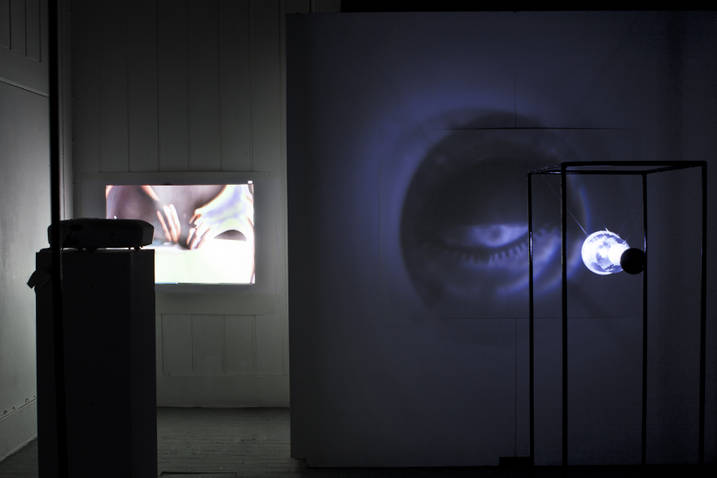
As a group we re-created the CO2 space perfectly. We covered the window then created a false ceiling to make the room dark and smaller. We also brought in false walls and created a hallway that directed people into the room and also created a little space for the video projection. Unfortunately the way that the video was projected detracted from the feel of the room, but had we had more time, we probably could have figured out a better way to show the video.

After we set everything up and I was able to run through it, a new idea about our collaborative project came into my mind. As I walked in I saw my sculpture with the paper and glass beads hanging from wood, I realized that could represent the beginning of human creativity and the materials used being that glass and paper are two of the few of humans’ oldest inventions. Then when I walked into the bigger part of the gallery space I saw the photo projections that reminded me of the next step of human documentation and creativity, which is created by light. Then finally it ended at the video projection which I felt represented humans’ current fascination with technology.


Regardless on what we could have changed and if it was a success or not to other people, I was very proud of the work that we created. 

Tuesday, 20 March 2012

Abstraction on Making Beads

Here is a short clip on my experiment of abstracting footage of me making beads to the point of mainly showing the motions.


Monday, 19 March 2012

My Narrow Critique on the Gallery Space as a Whole

Fresco in Pompeii

Lascauz Cave Paintings
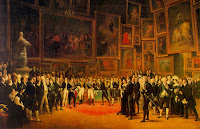
In the past couple hundred years the gallery space has become a matter of much debate. It could be said that the first gallery space was on the walls of caves approximately ten thousand years ago. Then it evolved into frescos for wealthy homeowners then to the walls of massive cathedrals or masques. However, it could be argued that the first official gallery was the Salon de Paris, which opened its first show in 1725.
Talbot Rice Gallery
Omayyad Mosque, Damascus, Syria


Salon de Paris


The Lightning Field 1977
Walter De Maria
Since then the gallery space evolved into what we now call the “White Space” which is exactly that, a room or rooms that is purely white to best show what work is being displayed. Then in the 1960’s until now artist felt that the white space was too oppressive, too closed-minded to other forms of art that is not painting, printmaking, sculpture or photography and too aggressively patriarchal. So these artists went beyond the white space. They went outdoors, to rundown factories, homes, and essentially anywhere else. Those spaces where then called “Brown Spaces”.

Now that I have very briefly and narrowly stated the history of the gallery space, I will state my opinion on the matter. What can be said about almost all of these spaces (save perhaps the cave paintings)? Except for a very few incidences, they were all for the rich, the educated, the people who were in the ‘know’.

When I was younger, perhaps between the ages of 11 to 14, I refused to be an artist. Even though I knew that I had artistic talent, I didn’t want to be apart of something that was so persistently closed-minded. Obviously this was in the mind of a very young girl who knew essentially nothing about the art world and the deep, messy hole it has turned into, I was biased toward what I saw. What did I see then? I saw people painting, creating things just for the sake of doing it, just for the sake of selfish ambition. The older I got the more educated I became and realized that art has a great potential of being something more than that. But the way that the art is displayed is still narrow. It confines itself to a specific audience who has far too much power in what is deemed as “good” art or “bad” art.

However, we as artists, have an amazing advantage with the Internet. When the Internet first became a thing, it was slow, small and few had access to it. Even now, we are realizing that the Internet is riddled with flaws. Also, when it first came about a few avant-garde artists used it to create their own work, which was still viewed and critiqued by the usual suspects. Regardless, more and more people around the world now have access to the Internet and the numbers are growing daily.

Though I am sure I could talk about the numbers to prove how much the Internet grows daily, the only example I am going to tell is more personal. When I was at the age of 17, I visited Uganda for the first time. When I left, the friends that I made there wanted to keep in touch, as did I. At the time there were two ways of keeping in contact. The first was by using “snail mail” which would sometimes make it all the way to the United States. The second mode of contact was via e-mail. The only way they could get e-mail was by visiting the local missionaries, which was the only way they could have access to Internet. However, five years later I came back to the same town called Kabale and during that time an Internet CafĂ© was opened. When I left Uganda the second time I had gained several friends on facebook whom since then I have chatted with and kept in continuous contact.

All of this to say that the Internet is growing, which should make our work as artists, or even activists, philanthropists, or anything really, easier. They will have more ability to show their work to the world, and perhaps aim to make it better. As a pessimist I know I speak naively, but it cannot be argued that at this moment, change is possible. 

Tuesday, 28 February 2012

Making the Beads and One Painting


Here is a video on how I make the beads while I watch a Bollywood movie.


Also, here is the first piece I made with the beads describing my frustration. The frustration being that I have been fortunate enough to be born into a position in life where I can actually attempt to make a difference in developing nations. However, because I am a white, middle-class American I receive a lot of criticism and am constantly asked if I even have a right to delve into the issues that I care most about. Sewing the white beads for me represented my burden and my chains.